Every enterprise runs a long tail of operations no core system covers — tracked in spreadsheets, personal databases and tools nobody approved. Komorado turns those into real systems, built in a conversation, on data your IT organization still controls.
It's a throughput problem. The requests that matter to one department rarely clear the bar for a platform team's roadmap — so they never get built, and the work moves into a spreadsheet instead.
Requests for internal systems arrive faster than any platform team can serve them. The long tail is structurally unfundable.
Spreadsheets on shared drives, unmanaged databases, SaaS bought on a card. Real operational data, outside your controls.
No access model, no audit trail, no owner when the person who built it leaves. The risk surface grows quietly.
A team describes what they need in plain language. Komorado proposes the structure — including who can see what — and builds it once someone with authority approves.
We need to track supplier quality incidents across our plants.
Here's the structure I'd build. Review each piece before anything is created.
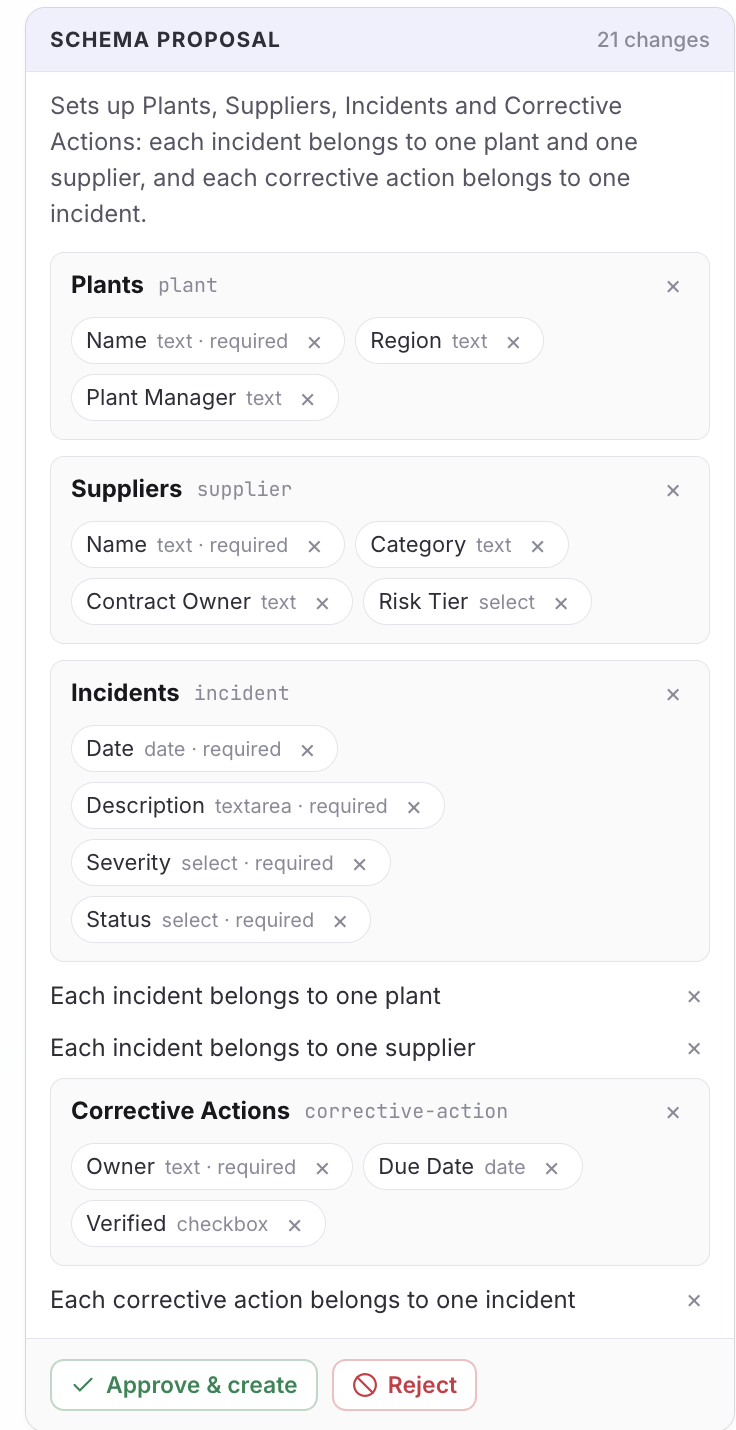
The team that has the problem writes the requirement — no intake form, no translation into a ticket, no waiting for a slot.
Tables, fields, relationships and the access model, all in plain language, before a single record exists.
The system goes live under your permissions model, with every change from that point recorded.
Komorado's assistant does real work — creates records, changes structure, moves people between teams. Every one of those actions is gated, logged and reversible by design, not by policy.
Anything consequential surfaces as a card explaining exactly what will change and what it affects. Nothing executes until a person with the authority says so.
Every action — human or AI — is recorded with who, what, when and what it touched. Answer "who changed this and why" without a forensics project.
Each change is shown as a diff with a single control to undo it. Mistakes are cheap, so teams move without fear.
Per-team and per-record permissions are part of the proposal itself. A system can't be created without an answer to who sees what.
Schema changes go through the same approval path as data. Your systems don't drift silently over months.
Routine operations run on fast, low-cost inference; structural design escalates to stronger reasoning. No model selection exposed to users.
The operational data that lives in a thousand spreadsheets today, consolidated — shaped to how each team actually works instead of forced into someone else's template.
Tables with the fields your process actually has, with filtering and views per team. No template to outgrow.
An incident belongs to a supplier and a plant. Open one and the full chain of related work is there.
Departments get systems shaped to them while the underlying data and controls stay common across the organization.
The automation layer over your data: when an incident closes, open the corrective action. Same conversation, same approvals.
Today Komorado builds systems from a description. The roadmap seeds them from the data your organization already has, and closes the loop on everything it doesn't know.
Connect the mailbox and the chat history. Komorado reads them, proposes the entities, and populates the records from what's already there. No blank slate.
"People keep asking about their order status." "Pricing questions arrive every day." Reported with evidence and volume, so you build what's actually happening.
An approved playbook answers on WhatsApp and email straight from your records. Same proposal, same approval, same audit trail.
When it can't answer, it says so and routes to a person. The human answer is saved, reviewable, and used next time. It gets better on your data, not someone else's.
We're working with a small number of organizations to put Komorado against their real internal-tools backlog. If that's a problem you own, we'd like to talk.
Founded by Tomer Meyer · Tel Aviv, Israel